- Bach Three Part Inventions for 7 String Guitar
When I bought my first seven string guitar a few years ago, I was expecting it to be a smooth graduation from six to seven strings. It took a few weeks to become able to actually just ignore that extra string and play regular six string guitar music. Slowly I started incorporating some of the lower notes, but for a long time it felt more like 6+1 strings. Jazz shell voicings were the next big step. Walking bass lines. Reading cello music at least gave some workout for that extra low string. But somehow I couldn’t find much music specifically written for seven string guitar – music that requires that low B string.
Eventually I realized that the extended range offered an opportunity to finally come up with playable versions of some of my favorite collections of classical music. The transcriptions in this volume are transposed versions of Bach’s originals. Having several independent parts going on simultaneously provides great opportunities to explore the fingerboard. If you improvise solo jazz guitar – melody, chords, bass lines – this is especially wholesome exercise in voice independence. Some pieces do require work past the 12th position on the seventh string.
In Bach’s original work the trills, mordents and other ornamentations figure prominently. I found them close to impossible to execute cleanly on the guitar so removed them (they are in the grand staff version).
I never liked to deal with guitar TAB unless absolutely necessary. On these pieces though, when I tried to decide how much fingering information should be written in, I noticed that the right amount would have really cluttered up the standard notation. It seemed better to just add a TAB staff and provide two versions: one in just standard notation, the other with standard and TAB notations. My suggested fingerings are however only that. The third section of this issue consists of grand staff versions with both staves in treble clef. Except for the transpositions, these preserve the presentation of the piano version.154 pages. Standard notation, TAB and grand staff
- Brazilian Suite No 2 for 7 string guitar
table of contents:
table of contents:
Bolero Melancólico
Canção Da Esperança
Chôro Com Uma Melodia
Incident At Deer Creek
Chôro MétricoComposed and arranged from 1992 to 2007. This suite was put together in 2006 and 2007. The fourth piece is an arrangement of a tune written in 1992 which has been recorded a few times. All five in this suite are currently for seven string guitar only. The first two Boleros are actually recorded. If there is any interest at all there might be a six string version. Writing and arranging in this style is very satisfying for me. I started out trying to read easy brazilian music when I started to play guitar around 1976. Villa-Lobos’ music always stayed on my music stand and as a Jazz player I always seemed to prefer latin music over swing and blues.
49 pages. Standard notation and TAB.
- Bach Cello Suites for 8 string Guitar
J. S. Bach’s six Cello Suites, here for 8 string guitar in standard notation bass clef.
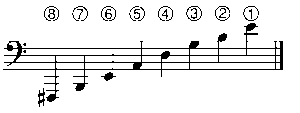
These are not in the original keys. All six suites are one fourth below the original key. Suite No 3 and 4 are presented in two different keys.
CELLO SUITE No. 1 in D (BWV 1007)
CELLO SUITE No. 2 in A (BMW 1008)
CELLO SUITE No. 3 in G & E (BWV 1009)
CELLO SUITE No. 4 in Bb & A (BWV 1010)
CELLO SUITE No. 5 in G minor(BWV 1011)
CELLO SUITE No. 6 in A (BWV 1012)108 pages.
- Brazilian Suite No 1 for 7 string guitar
table of contents:
Chôro Primavera
Chôro el Ninja
Bolero de Saudade
Chôro para Lorenzo
Chôro con FuegoComposed and arranged from 2005-2006. The five pieces in this suite started out as lead sheets. I liked practicing these lead sheets, playing the melody together with a simple bass line based on the chords. One day it dawned on me that some of these tunes might work as fully arranged classical guitar pieces. Thus the version for six string guitar came into being. Shortly thereafter I bought a seven string classical guitar which turned my guitar world upside-down. Thus the version for seven string guitar came about.
These five pieces are really challenging to play (at least for me).
48 pages. Standard notation and TAB.
- Three Waltzes for 7 string classical guitar
When I bought my first seven string guitar a few years ago, I was expecting it to be a smooth graduation from six to seven strings. It took a few weeks to become able to actually just ignore that extra string and play regular six string guitar music. Slowly I started incorporating some of the lower notes, but for a long time it felt more like 6+1 strings. Jazz shell voicings were the next big step. Walking bass lines. Reading cello music at least gave some workout for that extra low string. But somehow I couldn’t find much music specifically written for seven string guitar – music that requires that low B string.
The three waltzes were inspired by some of my favorite guitar pieces of paraguayan composer Agustín Barrios Mangoré.
For my wife and kids…
34 pages. Standard notation and TAB.
- Rhythmic and Harmonic Studies for Guitar
In 1981 I was practicing my scales: ionian, dorian, phrygian, lydian, mixolydian, aeolian, locrian, melodic and harmonic minor. Then I got a copy of the “Mahavishnu Songbook”. In it John McLaughlin showed a list of 13 (what he called) “Synthetic Scales”. I tried to practice these, but didn’t really know what to do with them – and a few really do sound very exotic. Eventually, in 1981, I wrote 13 short etudes, one for each scale. Ten years later I composed 14 more. None of these is hard to play, but written in their respective key signatures most of them are incredibly hard to read.
This book contains three versions of each piece:
The original version, notated in the applicable key signature(s).
The same, but without key signature, all accidentals are written out.
The original version with TAB notation.
Interesting is that some of these synthetic scales are modes (like lydian, mixolydian, etc are modes of the major ionian scale). For example Super Locrian and Overtone are related in that way, as are Neapolitan Major, Major Locrian, Lydian Minor, and Leading Whole Tone.
156 pages. Standard notation and TAB.
- Bach Three Sonatas And Partitas For 8 String Guitar
Better format. Easier to read (not easier to play, though). All in original keys plus Sonata 1 and all three Partitas in lower keys for extra workout.
162 pages. Standard notation only.
- Choros for Guitar and other Treble Clef Instruments
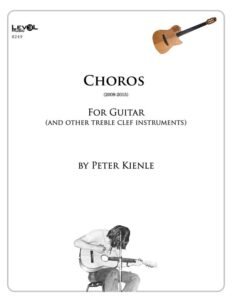
19 original choros. Good sight-reading exercises!
Includes standard and TAB notation.
